02 September 2010
Poster Venn
If you’ve presented or viewed posters, you’ve probably noticed there’s a lot of stuff on them that don’t really matter.
We put them on because we want to mimic scientific papers. References are a great example. Several of my colleagues are of the opinion that any academic work without a reference list is unacceptable. Listening to some, you’d think that such a poster would cause the conference hall to explode and leave every molecule in your body streaming away from the center of the blast at near the speed of light.
So we cave. We stick on a terminal reference list in Harvard format that nobody looks at. It might be shorter than the one in the published paper, but few dare to cut it entirely.
Graphic inspired by xkcd.
Related posts
References on posters
Containment
01 September 2010
Okay, you win
PowerPoint is the wrong tool for making posters.But it is the most popular software for doing so, by a wide margin. So says the survey I ran on my blog all summer long, though the thick of the conference season (1 May to 31 August).
Over the coming weeks and months, I plan dig in to find the features that might allow you to cobble together a decent poster in PowerPoint. I recently bought Office 2010, which obviously includes the latest version of PowerPoint. I never upgraded to PowerPoint 2007, so I’m just starting to learn where all the knobs and dials are in PowerPoint 2010 compared to the 2003 version.
I may be holding my nose while I write the PowerPoint posts. And I’ll be admonishing you to get a real graphics software package every time. But they will be coming.
26 August 2010
More power! The poster with a plug
One of the most unusual posters I saw at the International Congress of Neuroethology meeting in August was this one, being presented by Yossi Yovel:
You might not immediately recognize what’s different about this poster. Title, data, and boxes, the omnipresent boxes... It is mounted a little low. And some might recognized that the story has already been published, which is slightly unusual for a conference poster.
Allow me to point out...
The video screen.
That’s right, they were showing video of their bats behaving on their poster. This took some work. They found a cheap, small portable television, and they had to make a fairly complex set of adjustable metal braces, to allow for the fact that they didn’t know the size of the poster board. You need to be close to a power outlet, as you can see in this “behind the curtain” shot:
It seems a much more elegant solution than trying to find some space to hold up a laptop screen to someone. I got wondering if there was a simpler way to do this, and I thought of this.
Reference
Yovel Y, Falk B, Moss CF, Ulanovsky N. 2010. Optimal Localization by Pointing Off Axis. Science 327(5966): 701-704. http://dx.doi.org/10.1126/science.1183310
You might not immediately recognize what’s different about this poster. Title, data, and boxes, the omnipresent boxes... It is mounted a little low. And some might recognized that the story has already been published, which is slightly unusual for a conference poster.
Allow me to point out...
The video screen.
That’s right, they were showing video of their bats behaving on their poster. This took some work. They found a cheap, small portable television, and they had to make a fairly complex set of adjustable metal braces, to allow for the fact that they didn’t know the size of the poster board. You need to be close to a power outlet, as you can see in this “behind the curtain” shot:
It seems a much more elegant solution than trying to find some space to hold up a laptop screen to someone. I got wondering if there was a simpler way to do this, and I thought of this.
- Go online and buy some cheap second hand portable media player. There are lots that play video. An iPod nano, a Sansa, iRiver...
- Transfer the videos over.
- Add simple directions to the poster to the poster for how to see the video.
- Attach the player to your poster with some double sided mounting tape or something similar.
Reference
Yovel Y, Falk B, Moss CF, Ulanovsky N. 2010. Optimal Localization by Pointing Off Axis. Science 327(5966): 701-704. http://dx.doi.org/10.1126/science.1183310
21 August 2010
Academics and typefaces
Head over and see what Gripping Cell has to say on the subject. Hat tip to Biochembelle.
20 August 2010
Type crimes: Double feature
Yet again, proximity matters.
Photo by Wendie Lather on Facebook.
Additional: Oh dear. It’s a trend.
19 August 2010
Anything free is worth what you paid for it
“Free.”
The lure is strong, isn't it?
Dan Ariely has written about how "Free!" tugs hard on our decision making. We are overly likely to be lure in by the promise of anything free, even if it ends up costing you in the long run.
There are many free typefaces on the web. And you also get free fonts with some software packages, and most notably when you buy a new operating system. "It came with the system" is probably why Comic Sans became the cane toad of typefaces.
Font Feed discusses just how good free fonts are. The one point that I think is the most serious for academics making conference posters is number of characters:
Free and shareware fonts however are often restricted to the standard 26 letters of the alphabet, figures, and only the bare minimum of punctuation marks. It is quite common that suddenly you realise you can’t type that French name or that German idiom, nor put a ® next to a brand name nor a € next to a price, or that some punctuation mark is missing.
Or, if you're a scientist, put up that measurement in micrometers.
Caveat emptor!
Related posts
Incredible Presentations – Awesome Font Resources: SlideRocket post that covers both free and commerical sites.
Free fonts
Critique: RNAi and hepatitis C
Links
Picture by Lothann on Flickr. Used under a Creative Commons license. Yes, for free.
12 August 2010
Digital disasters
Michele Sullivan is a poster evangelist. She has a brilliant discussion of the joys of poster sessions:
...and a much needed check on an experimental format: the digital poster session.
This is the second time I’ve heard about a digital poster session. The first was from two colleagues in my department, who went to a small regional meeting (that shall remain nameless) earlier this year.
It was a disaster.
The were too many organizational problems in the set-up of the digital poster session to list, so I’ll just name one. The projector they used to show the posters was apparently not very good, and they projected on a wall rather than a screen, rendering almost everything unreadable. Nobody showed up for either the viewing or to answer questions.
Both my colleagues said it wasn’t worth their time.
I’m all in favour of innovation, but digital poster sessions need much more thought and tweaking before they can replace the traditional poster sessions. The essence of a poster session is the face to face, the personal. You have to corral the presenters and the viewers in the same room for the thing to work.
And you really need to read the rest of Michele’s post if you haven’t done so already.
Related links
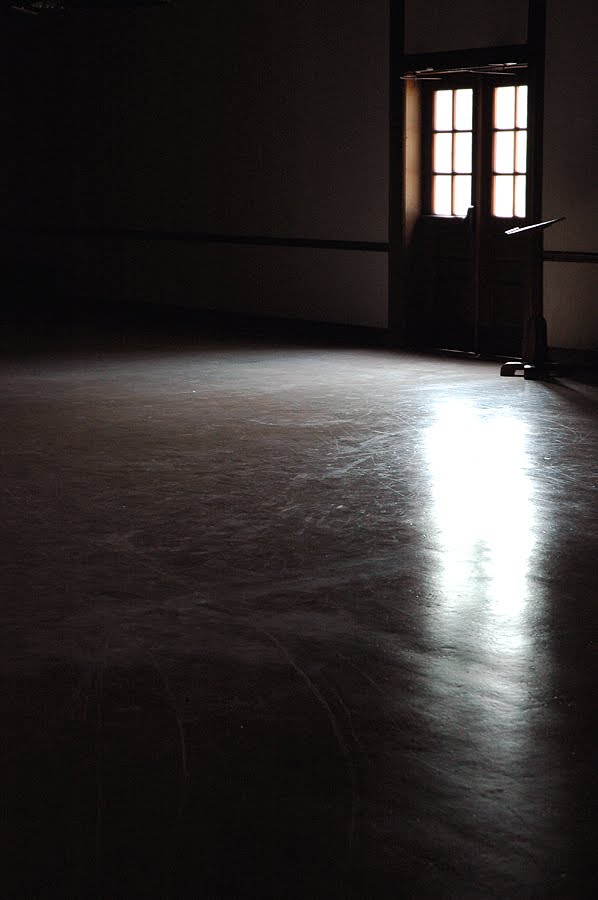
Empty room
Photo by Brian Hathcock on Flickr; used under a Creative Commons license.
Here are scientists just being themselves – taking pictures of friends proudly displaying their “babies,” unconcerned about microphones or accents, uninhibited by the formality of speaking before a crowd, congratulating the sharp conclusion, questioning the flawed method, pushing for the truth.
...and a much needed check on an experimental format: the digital poster session.
In almost 10 years of medical reporting, this is the first 100% digital poster session I’ve attended, and I have to say it was a sad sight.
This is the second time I’ve heard about a digital poster session. The first was from two colleagues in my department, who went to a small regional meeting (that shall remain nameless) earlier this year.
It was a disaster.
The were too many organizational problems in the set-up of the digital poster session to list, so I’ll just name one. The projector they used to show the posters was apparently not very good, and they projected on a wall rather than a screen, rendering almost everything unreadable. Nobody showed up for either the viewing or to answer questions.
Both my colleagues said it wasn’t worth their time.
I’m all in favour of innovation, but digital poster sessions need much more thought and tweaking before they can replace the traditional poster sessions. The essence of a poster session is the face to face, the personal. You have to corral the presenters and the viewers in the same room for the thing to work.
And you really need to read the rest of Michele’s post if you haven’t done so already.
Related links
Empty room
Photo by Brian Hathcock on Flickr; used under a Creative Commons license.
Subscribe to:
Posts (Atom)